
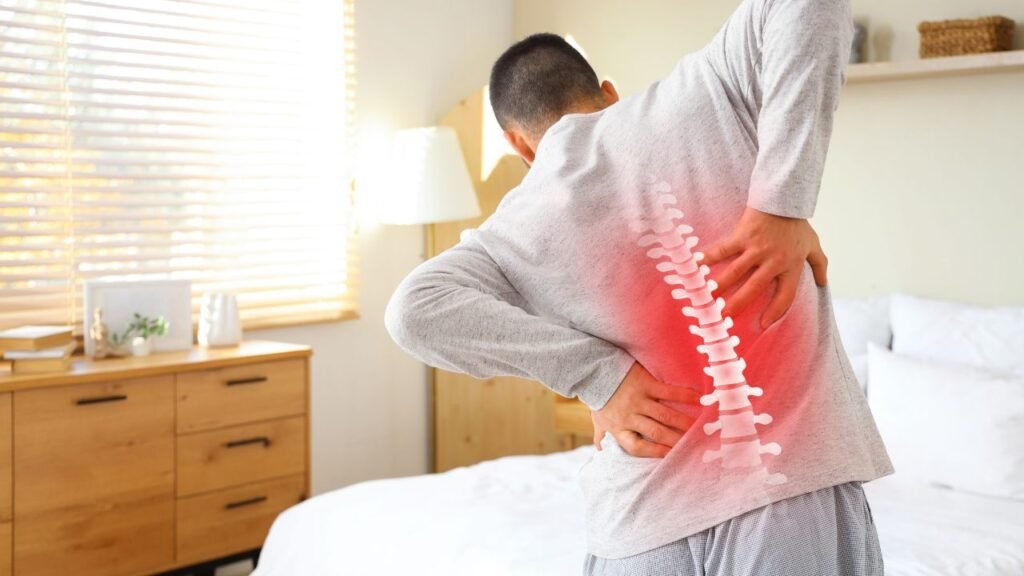
Lower left back pain affects millions of Americans, disrupting sleep, work, and the activities that make life enjoyable. Whether you’re experiencing sharp, shooting discomfort down your leg or a deep ache that worsens with certain movements, understanding the source of your pain is the first step toward effective relief.
This guide breaks down the most common causes of lower left back pain, explains when back pain symptoms warrant urgent evaluation, and clarifies when conservative care versus specialist intervention is appropriate.
Key Takeaways
- Most lower left back pain is mechanical (muscle strain, facet joint, SI joint, disc) and improves within 6-12 weeks with conservative care, movement, ice/heat, and gradual activity.
- Red flags require urgent evaluation: Saddle numbness, bowel/bladder changes, progressive weakness, fever with back pain, or severe trauma signal potentially serious conditions needing immediate attention.
- One-sided pain can originate from multiple structures: Facet joints, SI joints, disc herniations (90%+ at L4-L5/L5-S1), kidney issues, or referred hip pain. Each has distinct patterns and triggers.
- Imaging isn’t needed early without red flags: 80-90% of acute back pain resolves conservatively; imaging often shows age-related changes in asymptomatic people that don’t correlate with symptoms.
- Specialist evaluation is appropriate when: Conservative care fails after 6-12 weeks, function remains significantly limited, diagnostic uncertainty persists, or targeted joint injections could pinpoint the pain source and provide relief.
What Does “Lower Left Back Pain” Mean, And Where Is It Coming From?
Lower left back pain refers to discomfort in the left lumbar region, extending from the lower ribs to the top of the pelvis. Understanding the exact location helps identify the source, whether muscular, skeletal, nerve-related, or referred from internal organs.
What counts as the lower-left back?
- Low lumbar area (L4-L5, L5-S1 vertebral levels)
- Upper buttock region and sacroiliac (SI) joint area
- Flank region (lateral lower back)
Mechanical vs Non-Mechanical Pain
| Type | Common triggers | Typical feel | What makes it better/worse | When to worry |
| Mechanical | Lifting, twisting, prolonged sitting | Localized aching, movement-related | Better: rest, position changesWorse: specific movements | Weakness, numbness, bowel/bladder symptoms |
| Non-mechanical | No clear movement trigger | Constant, unrelated to position | Not affected by movement/rest | Fever, weight loss, night pain, systemic symptoms |
Why One-Sided Pain Can Come From Different Systems
Lower left back pain can originate from overlapping structures. Facet joints receive dual innervation from medial branch nerves at the same level and one level above, creating complex pain patterns. Kidney stones cause severe flank and groin pain that radiates to the back, while SI joint dysfunction creates buttock pain often perceived as “back pain.” Disc herniations at L4-L5 or L5-S1 (90%+ of cases) cause one-sided nerve compression with leg-dominant symptoms.
What Are The Most Common Causes Of Lower Left Back Pain?
Most lower left back pain stems from mechanical issues, muscles, ligaments, joints, or discs. Identifying the specific structure involved guides appropriate care and informs treatment options.
Muscle Strain / Ligament Sprain
Acute paraspinal muscle strain is the most common cause, occurring from improper lifting or twisting. Pain is localized, movement-related, and typically self-limiting, resolving within days to weeks with conservative care.
Facet Joint Pain vs SI Joint Pain
| Source | Where it hurts | Common triggers | Helpful movements | Clues it’s likely |
| Facet joint (L4-L5/L5-S1) | Paravertebral, may refer to buttock/thigh | Extension (arching), rotation | Forward bending often relieves | Worse with extension/rotation, doesn’t radiate below knee |
| SI joint | Buttock and groin, rarely below knee | Single-leg stance, stairs, prolonged sitting | Variable | Positive FABER/Gaenslen’s tests, aggravated by stairs |
Note: Diagnostic medial branch blocks require 50-75% pain relief to confirm facet pain. Dual blocks increase accuracy.
Bulging/Herniated Disc
Disc herniations at L4-L5/L5-S1 account for 90%+ of cases. A bulging disc (broad-based, intact annulus) is often asymptomatic. A herniated disc (focal, annular tear) is more likely to cause radicular leg pain. Critically, 80-90% improve within 6-12 weeks with conservative treatment, and disc findings on imaging don’t always correlate with symptoms.
When Is Lower Left Back Pain Nerve-Related, And What Does It Feel Like?
Nerve-related pain (radiculopathy) follows specific patterns down the leg, unlike muscle or joint pain that stays localized. Recognizing these patterns helps determine if nerve involvement requires specialized evaluation from a pain specialist.
Nerve Pain vs Muscle/Joint Pain
| Feature | Nerve-related | Muscle/joint-related |
| Pain quality | Sharp, shooting, electric, burning | Dull, aching, stiff |
| Radiation | Down leg in specific pattern (L5: lateral leg→dorsal foot; S1: posterior leg→plantar foot) | Localized, may refer to buttock but not below knee |
| Numbness/weakness | Common; specific patterns (L5: dorsal foot/great toe weakness; S1: lateral foot/toe walking weakness) | Rare |
| Cough/sneeze effect | Significantly worsens leg pain | Minimal effect |
Symptoms that suggest nerve irritation:
- Leg pain worse than or equal to back pain
- Positive Straight Leg Raise: radicular pain reproduced at 30-70 degrees
- Specific weakness (difficulty heel/toe walking)
- Numb patches in dermatomal patterns
Could My Lower Left Back Pain Be Coming From My Hip Or Pelvis Instead?
Hip and pelvic issues frequently masquerade as back pain. Distinguishing between these sources prevents misdiagnosis and delayed appropriate care.
Hip vs Back Pain
Hip arthritis or impingement causes groin/lateral hip pain that worsens with walking and improves with rest. Bursitis creates tenderness over the outer hip, aggravated by lying on that side. Weak glutes, tight hip flexors, altered gait, and leg-length discrepancies can overload one side and create compensatory back pain.
Could Lower Left Back Pain Be Caused By An Internal Organ?
Pain from the kidneys, GI organs, or reproductive structures can refer to the lower left back. Key differences in pain character, associated symptoms, and response to movement help distinguish organ-related from musculoskeletal causes.
Kidney Stone vs Kidney Infection vs Musculoskeletal
| Condition | Pain location | Other symptoms | Urgency | Next step |
| Kidney stone | Severe colicky flank→groin | Hematuria, nausea, can’t find comfortable position | Urgent (same day) | Urinalysis, CT/ultrasound |
| Kidney infection | Flank with CVA tenderness | Fever, chills, urinary symptoms | Urgent; needs antibiotics | Urinalysis, culture |
| Musculoskeletal | Localized to back, movement-related | No urinary/systemic symptoms | Non-urgent unless red flags | Activity modification, PT |
Signs It’s Organ-Related vs Spine-Related
| Clue | Why it matters | Recommended step |
| Fever | Infection (kidney, spinal abscess, diverticulitis) | Urgent evaluation; labs (CBC, CRP, urinalysis) |
| Urinary symptoms | Kidney stone or infection | Urinalysis, imaging |
| Abdominal pain predominant | GI or gynecologic source | GI/GYN evaluation |
| Pain unrelated to movement | Non-mechanical cause | Medical evaluation, imaging |
Note: Women should consider ovarian cyst/torsion, PID, or endometriosis if pelvic symptoms present. Diverticulitis presents as cramping lower left pain with fever/bowel changes.
What Symptoms Are “Red Flags” That Mean I Should Get Urgent Medical Care?
Certain symptoms signal potentially serious conditions requiring immediate evaluation. Recognizing these patterns prevents catastrophic complications and guides appropriate urgency.
Go now / urgent evaluation:
Neurologic emergency:
- Saddle numbness (perineum, buttocks, inner thighs), CAUDA EQUINA SYNDROME
- Bowel/bladder dysfunction (urinary retention, fecal incontinence)
- Progressive leg weakness or foot drop
- CES requires emergency MRI and surgery within 48 hours
Infection/vascular emergency:
- Fever + back pain (especially with IV drug use/immunosuppression), SPINAL ABSCESS
- Severe tearing pain + pulsatile abdominal mass + hypotension , AAA RUPTURE
Other urgent:
- Severe trauma with inability to move
- Known cancer + new persistent pain
- Unexplained weight loss >10 lbs + chronic pain
What Can I Do At Home In The First Few Days?
Early self-care focuses on gentle movement, inflammation control, and avoiding harmful rest patterns. Most acute back pain improves within days to weeks with appropriate home management.
Rest vs Keep Moving
| Do | Avoid | Why |
| Short rest (1-2 days max), gentle walking | Prolonged bed rest >2-3 days | Early mobilization promotes faster recovery; bed rest causes deconditioning |
| Light activity as tolerated | Heavy lifting, twisting, pushing through severe pain | Gradual movement maintains circulation |
Ice vs Heat / OTC Options
| Option | Use when | Best for | Safety notes |
| Ice | First 48-72 hours | Acute inflammation, spasm | 15-20 min with barrier; not >20 min |
| Heat | After 48-72 hours | Chronic stiffness, tension | Avoid if swelling present |
| NSAIDs | Most acute pain | Pain + inflammation | Take with food; avoid if GI bleeding/kidney disease |
| Acetaminophen | Can’t take NSAIDs | Mild-moderate pain | Max 3,000-4,000 mg/day total |
Stop home care and escalate if…
- Worsening weakness, foot drop
- New saddle numbness or bladder/bowel symptoms
- Fever developing
- Severe unrelenting pain
- Pain after significant trauma
How Do I Choose The Right Next Step Based On Duration?
Pain duration guides appropriate escalation from self-care to professional evaluation. Time-based decision-making balances conservative care with timely intervention when needed.
Under 6 weeks: Activity modification, ice/heat, OTC meds, gentle movement. Consider PT if not improving in 1-2 weeks. Watch for red flags.
6-12 weeks: Formal PT if not started. Evaluate nerve signs. Review ergonomics. Consider imaging if persistent despite conservative care.
Over 12 weeks: Chronic pain shifts to managing function, controlling flares, multidisciplinary approach (PT, pain psychology, possible interventional options).
When Imaging Is Appropriate
| Scenario | Imaging needed? | Why |
| Red flags present | Yes, urgently | Rule out fracture, infection, tumor, CES |
| Progressive neuro deficits | Yes | Identify nerve compression source |
| Persistent after 6-12 weeks conservative care | Consider | Identify structural causes |
| Acute pain <6 weeks, no red flags | No | Most resolve; imaging doesn’t correlate with symptoms |
What Will A Clinician Check?
A thorough evaluation combines detailed history and physical examination to identify the pain source, rule out serious pathology, and guide appropriate care. Specific questions and tests reveal patterns that narrow diagnostic possibilities.
Questions clinicians ask:
- Onset, triggers, radiation pattern (where exactly does it travel?)
- Numbness, tingling, weakness
- Systemic symptoms (fever, weight loss, night sweats)
- Urinary/GI symptoms
- Trauma, cancer, or infection risk factors
Physical exam checks:
- Range of motion (which movements reproduce pain?)
- Strength testing (great toe extension for L5, toe walking for S1)
- Reflexes (Achilles for S1)
- Straight Leg Raise (positive if reproduces leg pain at 30-70°)
- Hip/SI provocation tests
When Do I Need Imaging Or Tests?
Imaging timing depends on symptoms, duration, and red flags. Appropriate use prevents unnecessary exposure and focuses resources where they provide diagnostic value.
Why Imaging Often Isn’t Needed Early
For acute pain without red flags, imaging isn’t recommended in the first 6 weeks because 80-90% resolve with conservative care. Imaging often shows age-related changes (bulging discs, facet arthritis) present in asymptomatic people that don’t correlate with symptoms. Symptom-guided care is more useful early. Imaging becomes valuable with red flags, progressive symptoms, or failed conservative care.
MRI is the gold standard for soft tissues (discs, nerves, spinal cord). Used for red flags, persistent radiculopathy, progressive deficits, pre-procedure planning, or failed 6-12 weeks of conservative care.
Labs (CBC, CRP, ESR, urinalysis) used when infection, kidney issues, or inflammatory concerns suspected.
When Is It Time To See A Pain Specialist?
Specialist evaluation becomes appropriate when conservative care plateaus, function remains limited, or diagnostic uncertainty persists. Interventional options can pinpoint pain sources and provide targeted pain relief.
If function is significantly limited: Sleep, work, or daily activities are impaired beyond 6 weeks despite PT and medications.
If PT hasn’t helped enough: Completed 6-8 weeks of structured PT without improvement. A specialist can offer diagnostic injections (facet blocks requiring 50-75% relief, epidurals, SI injections) to pinpoint the pain source.
If medication reliance is growing: Need increasing doses for diminishing relief. Interventional options (like RFA providing 6-12+ months of relief) can reduce medication dependence.
If imaging doesn’t match symptoms: MRI shows degenerative changes, but unclear which causes pain, or normal imaging despite severe pain. Diagnostic injections confirm the source.
What Treatments Can A Pain Specialist Offer?
Pain specialists use diagnostic and therapeutic procedures to identify pain generators and provide targeted relief. Precision-guided techniques address specific structures while minimizing systemic medication exposure.
Common Procedures
| Procedure | Best-fit pattern | Target | Goal | Next step |
| Medial branch blocks | Paravertebral pain worse with extension/rotation | Nerves innervating facet joints | Diagnose facet pain (50-75% relief = positive) | Works: RFADoesn’t: Re-evaluate |
| RFA | Positive dual MBBs | Medial branch nerves | 6-12+ months relief | Repeat when returns |
| Epidural steroid injection | Radicular leg pain, nerve compression on MRI | Inflamed nerve root | Reduce inflammation, facilitate PT | Works: Continue PTDoesn’t: Consider surgery if progressive |
| SI joint injection | Buttock/groin pain, positive SI tests | SI joint | Diagnostic + therapeutic | Works: PT for stabilizationDoesn’t: Re-evaluate |
Non-procedure options: Targeted PT coordination, medication optimization (NSAIDs, gabapentin for nerve pain), behavioral pain strategies, flare planning.
For patients seeking alternatives to repeated cortisone injections, regenerative medicine options address underlying tissue damage rather than just reducing inflammation temporarily.
How Can I Prevent Lower Left Back Pain From Returning?
Prevention focuses on sustainable movement patterns, gradual progression, and addressing modifiable risk factors. Consistent habits reduce recurrence and build resilience against future episodes.
Daily habits:
- Movement breaks every 30-60 minutes
- Proper lifting mechanics (hip hinge, no twisting)
- Sleep quality (poor sleep amplifies pain sensitivity)
- Gradual loading (increase activity by ≤10% per week)
Strength priorities:
- Glute/hip strengthening (bridges, clamshells)
- Core endurance (planks, bird dogs , sustained holds)
- Hamstring mobility
- Thoracic mobility (reduce compensatory lumbar stress)
Common Questions About Lower Left Back Pain
“Why Does My Back Hurt More In The Morning?”
Morning stiffness occurs with degenerative disc disease because discs lose water overnight, increasing stress when you first load the spine. This typically improves with movement as discs rehydrate. Morning stiffness also results from sustained sleep postures creating muscle tension.
“What Exercises Are Safe vs Avoid?”
Safe: Walking, swimming, gentle core stabilization (pelvic tilts, modified planks), hip/glute strengthening (if tolerated).
Avoid: Heavy lifting with twisting, high-impact activities until pain controlled, excessive extension if facet pain.
Stop if: Radiating leg pain, numbness, tingling, or significant worsening. Do not exercise with red flags present.
What Should I Do Next If Not Improving?
Persistent or worsening symptoms warrant professional evaluation. Early intervention prevents chronic pain patterns and identifies treatable causes.
Book now if…
- Red flags present
- Progressive symptoms over days to weeks
- Persistent pain beyond 6-12 weeks despite conservative care
- Repeated flares increasing in frequency/severity
- Cannot work, sleep, or perform daily activities
Bring to appointment:
- Symptom timeline and pain map
- Triggers and relievers
- Medications tried (names, doses, effectiveness)
- Prior imaging (bring copies)
- Your goals: What do you want to be able to do again?
When Is It Time To See A Pain Specialist? Take The Next Step Toward Lasting Relief
Lower left back pain is common, and most cases resolve with conservative care, movement, appropriate rest, and gradual activity progression. Understanding the difference between mechanical pain (muscle strain, facet joint, disc) and non-mechanical causes (kidney issues, infection) helps you make informed decisions about when to self-manage and when to seek professional evaluation.
See a specialist if red flags are present, persistent beyond 6-12 weeks despite conservative care, radicular symptoms (leg pain/numbness/weakness), significant functional impairment, increasing medication reliance, or diagnostic uncertainty.
Patients frustrated with temporary relief from repeated cortisone shots may benefit from exploring regenerative approaches that support long-term tissue health. Understanding the difference between symptom relief and long-term joint support empowers you to make informed treatment decisions.
Most importantly, you don’t have to accept chronic pain as permanent. With the right diagnosis and treatment approach, you can return to the activities you love and reclaim your quality of life.
If lower left back pain is limiting your life and conservative care hasn’t provided relief, our team can help identify the source and create a personalized treatment plan.

