
Back pain radiating down your leg can signal several spinal conditions, but two of the most common culprits are bulging discs and herniated discs. While these terms are often used interchangeably, they represent distinct structural problems with different implications for treatment and recovery.
Understanding the key differences, from anatomy and symptoms to treatment timelines and surgical indications, can help you navigate your diagnosis with confidence and make informed decisions about your spine care.
Key Takeaways
- Bulging discs have an intact outer layer affecting >50% of the disc; herniated discs involve a tear with nucleus material extruding through. This structural difference determines symptom severity and treatment.
- 80-90% of disc herniations improve within 6-12 weeks with conservative care, physical therapy, activity modification, and anti-inflammatory treatment, without surgery.
- Herniated discs cause radicular symptoms (leg pain, numbness, weakness) because extruded material compresses nerve roots, especially at L4-L5 and L5-S1 levels.
- Cauda equina syndrome (saddle numbness, bowel/bladder dysfunction, bilateral leg weakness) is a surgical emergency requiring decompression within 48 hours to prevent permanent damage.
- Core strengthening, proper lifting mechanics, weight management, and smoking cessation significantly reduce your risk of future disc problems.
What Is A Bulging Disc?
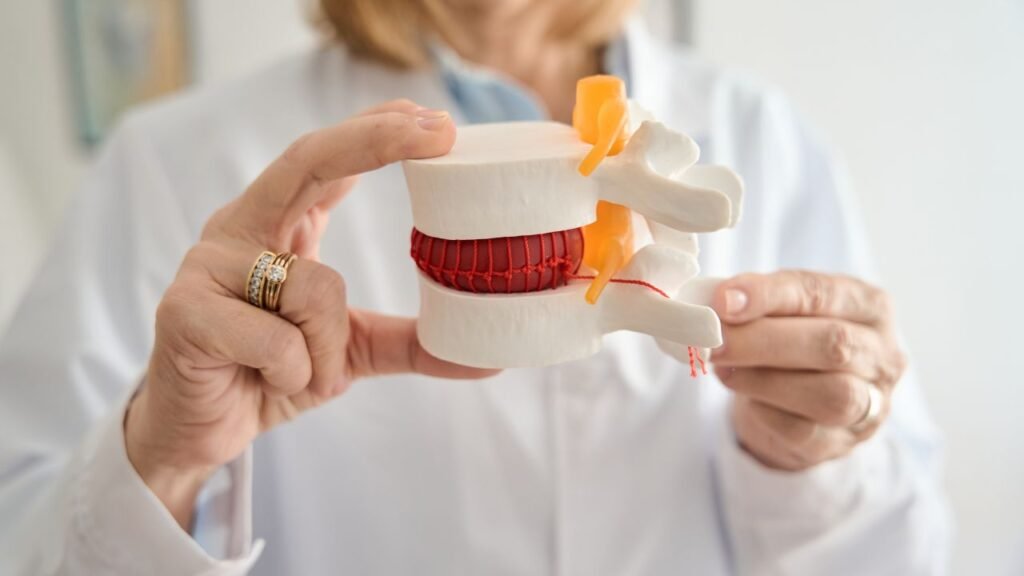
A bulging disc occurs when the disc material extends beyond the normal edges of the vertebrae, affecting more than 50% of the disc’s circumference. Think of it like a tire that bulges evenly outward as it ages and loses pressure. The outer layer of the disc, the annulus fibrosus, remains intact, though it may be weakened or stretched.
Bulging discs are extremely common and often develop naturally with age. Most cause no symptoms at all and are discovered incidentally on imaging studies performed for other reasons.
Can A Bulging Disc Cause Pain?
Most bulging discs are asymptomatic. When symptoms do occur, they typically present as mild, diffuse back pain without leg involvement.
Can A Bulging Disc Cause Numbness Or Weakness?
Rarely. Because the disc material doesn’t typically compress nerve roots, neurological symptoms like numbness, tingling, or weakness are uncommon with simple disc bulges.
Can A Bulging Disc Exist Without Symptoms?
Yes. Disc bulges are frequently found on MRI scans of people with no back pain. They’re often a normal part of spinal aging rather than a pathological condition requiring treatment.
What Is A Herniated Disc?
A herniated disc, also called a herniated nucleus pulposus (HNP), occurs when the disc’s tough outer layer (annulus fibrosus) tears, allowing the soft, gel-like inner material (nucleus pulposus) to push through. Unlike a bulging disc, a herniation is focal, affecting less than 180 degrees of the disc’s circumference.
Herniations are classified by severity. A protrusion is a focal herniation where the base is wider than the displaced portion; it may or may not compress nearby nerves. An extrusion occurs when the displaced material has a narrower base than the extruded portion but remains connected to the disc, creating a higher likelihood of nerve compression. A sequestration represents a completely separated disc fragment that can migrate and often causes significant nerve compression.
Why Is A Herniated Disc More Likely To Irritate A Nerve?
The extruded disc material can directly compress spinal nerve roots, particularly when herniations occur in the posterolateral direction, where the protective posterior longitudinal ligament is weakest. The L4-L5 and L5-S1 levels account for over 90% of lumbar disc herniations due to high biomechanical stress at these segments.
Can A Herniated Disc Result From Wear And Tear?
Yes. Most herniations occur in discs already weakened by degenerative changes. The disc gradually loses water content and structural integrity, making it vulnerable to tearing even with routine activities.
Can A Herniated Disc Happen After An Injury?
Absolutely. A sudden, forceful movement, improper lifting, a fall, or a twisting motion can cause an acute annular tear and immediate herniation, particularly in a disc with pre-existing degeneration.
What Is The Difference Between A Herniated Disc And A Bulging Disc?
| Feature | Bulging Disc | Herniated Disc |
| Disc shape | Broad-based, circumferential extension (>180° or >50% of disc) | Focal, asymmetric protrusion (<180° of disc) |
| Outer layer involvement | Annulus fibrosus remains intact (though may be weakened) | Tear or rupture in annulus fibrosus allows nucleus to push through |
| Does disc material leak outward? | No, outer layer prevents leakage | Yes, nucleus pulposus extrudes through tear |
| Likelihood of nerve compression | Low, rarely compresses nerves | Higher, extruded material more likely to compress nerve roots |
| Common symptom pattern | Often asymptomatic; when symptomatic: mild, diffuse axial back pain | Sharp, shooting radicular pain (sciatica) radiating down leg; neurological symptoms |
| Typical severity range | Mild to moderate | Moderate to severe |
| Usual first-line treatment | Observation, physical therapy, activity modification | Conservative care (PT, ESIs), with 80-90% improving in 6-12 weeks |
On MRI, these differences are clearly visible. A bulging disc appears as a broad-based, smooth, symmetric extension beyond the vertebral body on T2-weighted images. A herniated disc shows a focal, asymmetric protrusion, and the scan can demonstrate whether the herniation is compressing a nerve root or the thecal sac.
A bulging disc can progress to a herniated disc over time, particularly if the annulus continues to weaken. This progression isn’t inevitable, many bulges remain stable for years, but ongoing degenerative changes or additional trauma can convert a bulge into a frank herniation.
What Symptoms Can A Bulging Disc Or Herniated Disc Cause?
Symptoms depend primarily on whether a nerve is compressed and which spinal level is affected. Bulging discs typically cause minimal symptoms because they rarely contact nerve structures. Herniated discs, particularly extrusions and sequestrations, are far more likely to generate nerve-related symptoms and disc pain that radiates beyond the spine.
Common symptoms include:
- Localized back or neck pain
- Arm pain or leg pain (radiculopathy)
- Tingling sensations in the extremities
- Numbness in specific dermatome patterns
- Muscle weakness in affected muscle groups
- Pain that worsens with certain movements (bending, twisting, lifting)
The hallmark of a compressive herniated disc is radicular pain, sharp, shooting, electric-like pain that radiates from the spine down the leg along a specific nerve pathway. The pattern of symptoms reveals which nerve root is compressed:
| Herniation Level | Nerve Root | Pain Radiation | Motor Weakness | Reflex Change | Sensory Loss |
| L4-L5 | L5 | Lateral leg → dorsal foot → great toe | Great toe extension; difficulty heel walking | Minimal (medial hamstring) | Dorsal foot; web space between 1st-2nd toe |
| L5-S1 | S1 | Posterior leg → plantar foot → lateral foot | Plantar flexion; difficulty toe walking | Ankle (Achilles) reflex diminished/absent | Lateral foot; plantar surface |
The Straight Leg Raise (SLR) test helps confirm the diagnosis during physical examination. When the examiner passively lifts the patient’s straight leg and reproduces the characteristic radicular pain (not just hamstring tightness) at 30-70 degrees of elevation, it strongly suggests lumbar disc herniation with nerve root compression.
When Is A Herniated Disc Or Bulging Disc AMedical Emergency?
Most disc problems resolve with chronic pain management, but certain symptoms signal serious nerve compression requiring immediate medical attention. Cauda equina syndrome (CES), a neurosurgical emergency caused by severe compression of the nerve bundle at the base of the spine, demands urgent intervention to prevent permanent neurological damage.
Seek emergency care immediately if you experience:
- Worsening weakness in one or both legs
- Severe or rapidly progressing nerve symptoms
- Loss of bladder control or urinary retention (inability to urinate)
- Loss of bowel control or fecal incontinence
- Numbness in the saddle area (perineum, buttocks, inner thighs)
- Bilateral leg weakness or paralysis
- Sexual dysfunction or loss of genital sensation
CES is characterized by the classic triad of saddle anesthesia, bowel/bladder dysfunction, and bilateral lower extremity weakness. Prompt surgical decompression, ideally within 48 hours of symptom onset, is associated with significantly better outcomes for recovery of sensory, motor, and bladder/bowel function. Untreated CES can result in permanent neurological deficits, including irreversible paralysis and incontinence. While surgery after 48 hours may still provide improvement, the window for optimal recovery narrows significantly with delay.
What Causes A Bulging Disc Or Herniated Disc?
Age-related disc degeneration is the primary driver of both bulging and herniated discs. The process begins with disc dehydration as the nucleus pulposus, the gel-like disc center, progressively loses proteoglycan content. Proteoglycans are large molecules that attract and bind water, giving the disc its hydrostatic properties and shock-absorbing capacity. As these molecules degrade with age, the disc loses turgor and becomes less resilient under compressive loads.
As dehydration progresses, the disc loses height, increasing mechanical stress on facet joints and surrounding ligaments. The annulus fibrosus, the tough outer ring, weakens over time and develops annular tears that can allow the nucleus to migrate or extrude outward.
Common contributors and risk factors include:
- Heavy lifting with improper technique
- Repeated strain from occupational or recreational activities
- Twisting movements, particularly under load
- Poor posture during sitting, standing, or lifting
- Excess body weight placing increased spinal load
- Smoking (impairs disc nutrition and accelerates degeneration)
- Physically demanding work requiring repetitive bending or lifting
- Prolonged sitting without adequate lumbar support
How Do Doctors Diagnose A Bulging Disc Or Herniated Disc?
Diagnosis begins with a thorough clinical evaluation combining symptom history and physical examination. Imaging is reserved for cases with neurological symptoms, persistent pain despite conservative treatment, or red flag features suggesting serious pathology.
During examination, your clinician will assess:
- Pain pattern (location, radiation, aggravating/relieving factors)
- Numbness distribution along specific dermatomes
- Weakness in muscle groups corresponding to nerve roots
- Reflex changes (diminished or absent reflexes)
- Range of motion limitations
- Straight leg raise or similar nerve tension testing to reproduce radicular symptoms
MRI is the gold standard for visualizing disc pathologies and neural compression. On T2-weighted sequences, a bulging disc appears as a broad-based, smooth, symmetric extension beyond the vertebral body. A herniated disc shows a focal, asymmetric protrusion, and the scan clearly demonstrates whether the herniation compresses a nerve root or the thecal sac.
The degree of nerve root compression and the presence of disc extrusion or sequestration are critical factors in treatment planning. A CT myelogram, involving contrast dye injection into the spinal canal followed by CT scanning, provides excellent nerve root detail and is used for surgical planning when MRI is contraindicated or findings are ambiguous.
Imaging is generally not recommended for acute, uncomplicated lower back pain without red flags, as the majority of cases resolve spontaneously within weeks. Importantly, imaging findings don’t always correlate with symptom severity, many asymptomatic individuals have disc bulges or even herniations on MRI. Treatment decisions should be based on clinical presentation rather than imaging alone.
How Are Herniated Discs And Bulging Discs Treated?
Treatment for disc-related pain typically begins with conservative, non-surgical approaches. The vast majority of patients with acute lumbar disc herniations can be managed successfully without surgery. Studies consistently show that 80-90% of patients with lumbar disc herniations experience significant improvement or complete resolution of symptoms within 6-12 weeks with non-operative treatment.
Nonsurgical treatment options include:
- Modified activity (avoiding aggravating movements while maintaining general activity)
- Short-term rest without prolonged inactivity (bed rest beyond 1-2 days delays recovery)
- Pain relievers (acetaminophen, NSAIDs)
- Anti-inflammatory medications to reduce nerve root inflammation
- Physical therapy, particularly programs focusing on core stability and directional preference exercises (McKenzie method), is highly effective for long-term recovery
- Heat or ice application for symptomatic relief
- Epidural steroid injections in selected cases deliver potent anti-inflammatory medication directly to the site of nerve compression, providing significant pain relief and facilitating participation in physical therapy
For bulging discs, treatment is often unnecessary if asymptomatic. When mild pain is present, management consists of observation, physical therapy to improve core strength and posture, and activity modification to avoid aggravating movements.
The body’s natural healing process works in your favor: extruded disc material is recognized as foreign by the immune system, triggering an inflammatory response that leads to gradual resorption and shrinkage of the herniated fragment over time.
Surgery is generally reserved for persistent, disabling pain that has failed 6-12 weeks of comprehensive conservative care, progressive neurological deficits (worsening weakness or numbness), or serious nerve compression causing cauda equina syndrome. Microdiscectomy, minimally invasive removal of the herniated disc fragment, provides excellent relief of radicular leg pain with success rates exceeding 90%.
For patients seeking alternatives to repeated steroid injections, regenerative medicine approaches may support the body’s natural healing capacity through advanced biologics.
Which Surgery Options Are Used For A Herniated Disc?
Surgical intervention is reserved for specific indications when conservative care has failed or when neurological compromise threatens permanent damage. The overwhelming majority of disc herniations resolve without surgery.
| Procedure Name | What the Procedure Does | When It May Be Considered |
| Microdiscectomy | Minimally invasive procedure using a microscope to make a small incision and remove only the herniated portion of the disc compressing the nerve root | Standard procedure for lumbar disc herniation; success rate for relieving radicular leg pain typically exceeds 90% |
| Discectomy | Surgical removal of herniated disc material through a larger incision | When conservative care has failed after 6 weeks to 3 months and persistent, disabling radicular pain continues |
Cauda equina syndrome, involving bowel/bladder dysfunction, saddle anesthesia, and bilateral leg weakness, is a surgical emergency requiring immediate decompression. Progressive neurological weakness, such as a developing foot drop, is an urgent indication for surgery to prevent permanent nerve damage.
Elective surgery is considered for persistent, disabling radicular pain that has not improved after at least 6 weeks to 3 months of comprehensive non-operative care, or for severe functional impairment that prevents work or daily activities. Surgery is far less commonly needed for a bulging disc.
Because bulges rarely compress nerves significantly, surgical intervention is considered only when symptoms are severe, persistent, and clearly attributable to the bulge despite exhaustive conservative treatment, an uncommon scenario.
How Long Does It Take To Recover From A Bulging Disc Or Herniated Disc?
Recovery timelines vary based on treatment approach and individual factors, but most patients improve substantially within weeks to months.
| Recovery Timeline | Details |
| Conservative treatment (no surgery) | 80–90% of patients experience significant improvement or complete resolution within 6–12 weeks |
| After microdiscectomy surgery | Patients typically walk the same day; return to sedentary work within 2–4 weeks; return to heavier activities in 2–3 months |
| Long-term outcomes (2-4 years) | The landmark SPORT trial demonstrated that while surgically treated patients had faster and more significant initial pain relief, outcomes at 2–4 years follow-up were comparable between surgical and non-surgical groups |
| Recurrence rate after surgery | 5–15% risk of recurrent disc herniation at the same level |
| Factors that can slow healing | Smoking, poor core strength, continued heavy lifting, inadequate physical therapy compliance, obesity |
The favorable natural history of herniated discs means patience with conservative care is well-justified. Most patients who avoid surgery achieve outcomes comparable to surgical patients by the 2-year mark, though the surgical group experiences faster initial relief.
Which Treatment Option May Be Best For Your Symptoms?
| Symptom Pattern | Likely First Step | When to Seek More Advanced Care |
| Mild pain without neurologic symptoms | Observation, physical therapy, activity modification, NSAIDs | If pain persists beyond 6 weeks or worsens |
| Pain with tingling or numbness | Physical therapy (McKenzie method), NSAIDs, consider epidural steroid injection | If symptoms progress or don’t improve within 6-12 weeks |
| Persistent pain despite conservative care (6+ weeks) | Re-evaluation; consider epidural steroid injection, advanced imaging (MRI), specialist consultation | If conservative measures fail after 3 months |
| Weakness or worsening neurologic symptoms | Urgent specialist evaluation, MRI, possible surgical consultation | Immediately, progressive neurological weakness may require surgery to prevent permanent nerve damage |
| Bowel/bladder dysfunction, saddle numbness, bilateral leg weakness | Emergency room immediately | This is cauda equina syndrome, surgical emergency requiring decompression ideally within 48 hours |
Choose regenerative approaches if: You’ve experienced temporary relief from steroid injections but want to address underlying tissue health. Stem cell therapy for back pain and BMAC therapy for chronic joint pain may support disc healing and reduce inflammation at the cellular level.
Consider traditional interventions if: You need rapid symptom relief to participate in physical therapy, or if your pain is primarily inflammatory rather than structural.
How Can You Prevent Another Disc Injury?
Prevention focuses on maintaining a healthy weight, regular core strengthening and flexibility exercises, and using proper body mechanics and lifting techniques. Reducing modifiable risk factors significantly lowers the likelihood of future disc problems.
Prevention strategies include:
- Improving posture during sitting, standing, and all daily activities
- Using better body mechanics for bending, twisting, and reaching
- Lifting safely by keeping loads close to your body, bending at the knees, and avoiding twisting while lifting
- Maintaining a healthy weight to reduce axial load on the lumbar spine
- Staying active with regular low-impact exercise like walking, swimming, or cycling
- Strengthening core and back muscles through targeted exercises that stabilize the spine
- Avoiding smoking accelerates disc degeneration by impairing disc nutrition through its effects on the microvasculature, and smoking cessation is strongly recommended
- Reduce prolonged sitting when possible; take frequent breaks to stand and move
A comprehensive prevention program addresses biomechanical stresses, maintains tissue health, and builds resilience against future injury.
What Should You Remember About Herniated Disc vs Bulging Disc?
A bulging disc involves more than 180 degrees of the disc circumference with an intact outer layer. A herniated disc is a focal protrusion with a tear in the annulus, allowing the nucleus pulposus to extrude through.
Both cause back pain, but herniated discs are far more likely to produce radicular symptoms, sharp leg pain, numbness, and weakness, because extruded material compresses nerve roots. Bulging discs rarely generate neurological symptoms.
The prognosis is favorable: 80-90% of disc herniations improve within 6-12 weeks with conservative care. Physical therapy, activity modification, and anti-inflammatory medications should be the first approach.
Evaluation becomes critical when symptoms are severe, persistent, or progressive. Cauda equina syndrome requires immediate surgical decompression within 48 hours. Progressive neurological weakness demands urgent surgery to preserve function. For most patients, time and appropriate conservative care resolve the problem without surgical intervention.
If you’re experiencing persistent back pain, leg pain, or neurological symptoms from a herniated or bulging disc, schedule your consultation today to explore personalized treatment options designed to support your body’s natural healing capacity.

