
Most adults experience back pain at some point, but knowing when that pain signals degenerative disc disease, and when to seek treatment, can prevent years of unnecessary suffering. Many dismiss early warning signs as “just getting older,” missing the critical window when conservative intervention proves most effective. Recognizing the early signs of disc degeneration and understanding common back pain causes allows for timely intervention with non-surgical treatment approaches that can halt progression and restore function.
This guide identifies when conservative care becomes necessary, which symptoms require professional evaluation, and how to distinguish disc-related pain from other conditions.
Key Takeaways
- Degenerative disc disease causes mechanical pain worsened by sitting, bending, and lifting, but improved by lying down or walking. This position-dependent pattern helps distinguish disc issues from muscle strains or nerve compression.
- Most early degenerative disc disease responds to 6-12 weeks of conservative care, including physical therapy, activity modification, and proper movement mechanics, without surgery or long-term medication.
- Seek urgent evaluation for red flags: Bowel/bladder changes, saddle numbness, or rapidly progressive weakness require emergency assessment to rule out cauda equina syndrome requiring intervention within 48 hours.
- Imaging is not always necessary for early symptoms. MRI becomes appropriate after 6+ weeks of persistent symptoms despite conservative care, when red flags are present, or when neurological deficits develop.
- Lifestyle factors significantly influence outcomes: Smoking cessation, weight management, regular walking, proper lifting mechanics, and sleep optimization reduce symptom severity and recurrence risk independent of other treatments.
What Is Degenerative Disc Disease, And What Does “Degeneration” Actually Mean?
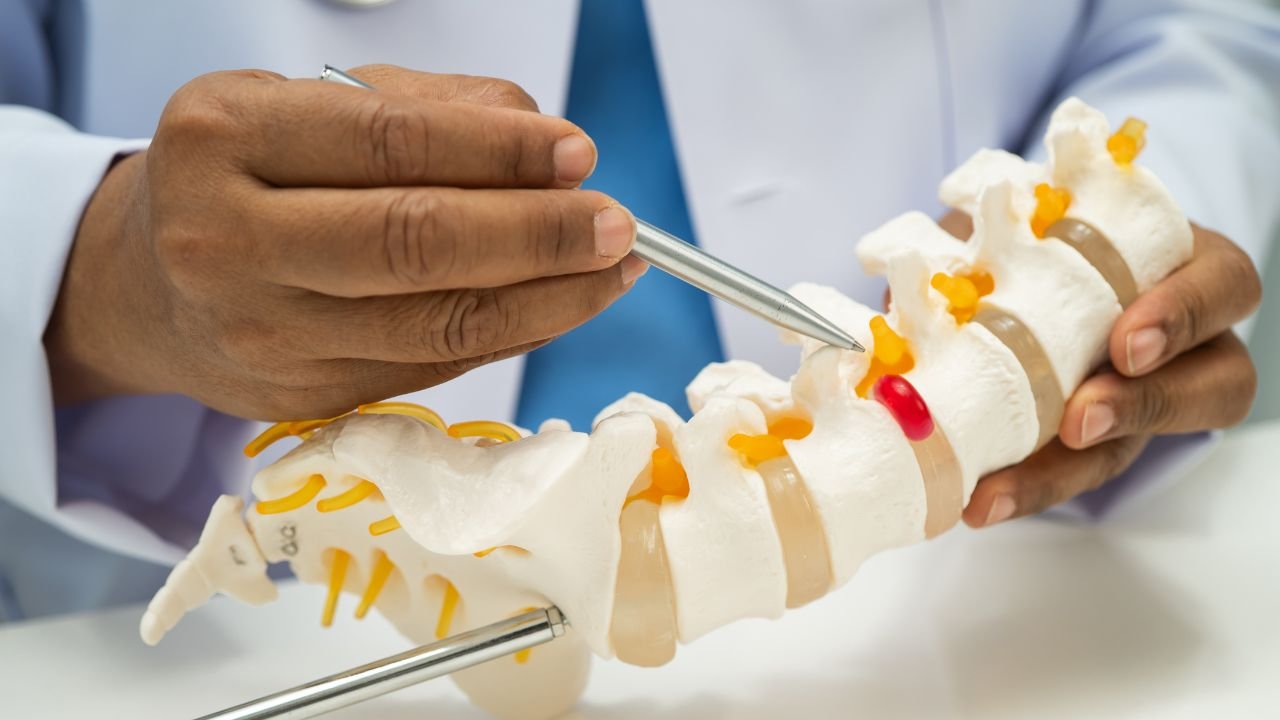
Degenerative disc disease (DDD) describes age-related changes in spinal discs between vertebrae. As discs lose water content, specifically proteoglycans in the nucleus pulposus, their shock-absorbing capacity diminishes. Disc height decreases, transferring abnormal stress to the surrounding vertebrae and facet joints. The outer annulus fibrosus develops microscopic tears, potentially allowing inner disc material to bulge outward. MRI scans may reveal Modic changes in vertebral endplates, indicating bone marrow alterations from abnormal mechanical stress.
While disc changes occur naturally with aging, DDD becomes clinically significant when it produces pain and functional limitations. Not everyone with disc degeneration experiences symptoms; imaging studies show disc changes in 40% of people under 30 and 90% of those over 60, many without pain. This disconnect between imaging findings and symptoms underscores the importance of treating the person, not the scan.
Where symptoms appear:
- Lower back (most common): Dull, achy pain in lumbar spine centered around L4-L5 or L5-S1 levels; referral into buttocks or thighs (typically not below knee); morning stiffness improving with movement after 30-60 minutes
- Neck (less common): Cervical spine pain with potential referral into shoulders or arms; may worsen with certain head positions or prolonged computer work
Major contributing factors:
- Age-related proteoglycan degradation (begins in third decade of life)
- Smoking (impairs disc nutrition through microvasculature damage, reducing nutrient delivery to avascular disc tissue)
- Repetitive loading from heavy lifting, manual labor, or prolonged sitting occupations
- Obesity (increases axial spinal load by estimated 10+ pounds per pound of excess body weight)
- Genetic predisposition (family history of disc disease)
What Are The Early Signs Of Degenerative Disc Disease?
Early DDD presents with mechanical pain patterns distinct from acute muscle strains or nerve compression. Recognizing these patterns helps differentiate disc issues from other back pain causes and guides appropriate treatment decisions.
Common early warning signs:
- Achy, mechanical pain: Dull rather than sharp; deep-seated centrally in spine rather than surface-level; quality often described as “stiff,” “tight,” or “aching.”
- Position-dependent symptoms: Worse with sitting (increases intradiscal pressure by 40-50%), forward bending, or lifting; improved when lying flat (reduces disc loading) or walking (gentle movement promotes disc nutrition)
- Morning stiffness: First-hour stiffness that decreases with movement; reflects overnight disc dehydration and reduced nucleus pulposus hydration during prolonged static positioning
- Episodic flare-ups: Pain comes and goes rather than remaining constant; “good weeks” alternate with “bad weeks”; not consistently present
- Activity-triggered pain: Specific movements or prolonged positions predictably worsen symptoms (prolonged driving, gardening, vacuuming, carrying children)
How symptoms evolve over time: Most early DDD follows an episodic pattern with symptom-free intervals between flares lasting days to weeks. Initial episodes may resolve completely within 48-72 hours. As the condition progresses, flare frequency may increase and recovery periods may lengthen.
Triggers include prolonged sitting (flights exceeding 2 hours, desk work without breaks), lifting objects even of moderate weight (10-20 pounds), or physical activities performed after periods of inactivity (weekend warrior syndrome). Understanding your specific triggers helps prevent future episodes.
Early radiating pain characteristics: Pain may extend into the buttocks, hips, or posterior thighs, but typically remains above the knee in pure DDD without nerve involvement. This referral pattern reflects shared nerve innervation between discs and surrounding structures, not true nerve compression. Absence of numbness, tingling, or leg weakness distinguishes disc degeneration from nerve root compression (radiculopathy).
Pain extending below the knee, foot numbness or tingling, difficulty raising the foot (foot drop), or calf weakness suggest nerve involvement requiring a different evaluation and potentially more urgent intervention.
How Do I Know If My Pain Is Disc-Related Or Something Else?
| Likely Cause | Pain Location | Makes It Worse | Makes It Better |
| Disc-related | Central lower back; buttocks/thighs | Sitting >30 min, bending, lifting | Lying flat, walking, position changes |
| Muscle strain | Localized paraspinal muscles | Movement, palpation | Rest, heat/ice |
| Facet/joint pain | Paravertebral (L4-L5/L5-S1) | Extension, rotation | Forward bending |
| Nerve-related | Sharp leg pain to foot | Prolonged sitting, coughing | Avoiding nerve compression |
Key disc pain differentiators:
- Worsens with increased abdominal pressure (coughing, sneezing)
- Improves with spinal unloading (lying supine)
- Centrally located in the early stages
- Follows mechanical pattern, not nerve distribution
When Should I Seek Non-Surgical Treatment Instead Of Waiting It Out?
Seek professional evaluation when:
- Pain persists beyond 4-6 weeks: Persistence suggests structural involvement requiring intervention
- Recurring flare-ups despite modifications: Underlying disc changes require professional management
- Daily function becomes limited: Pain interferes with work, sleep, or routine activities
Practical functional thresholds:
- Cannot sit/stand >20-30 minutes without pain escalation
- Difficulty with routine objects (grocery bags, laundry)
- Sleep is interrupted most nights
Early intervention with physical therapy, activity modification, and regenerative approaches can prevent progression from episodic discomfort to chronic disability.
What Symptoms Mean I Should Seek Evaluation Urgently?
EMERGENCY (go to ER immediately):
- Bowel/bladder changes (loss of control, retention)
- Saddle numbness (perineum, buttocks, inner thighs)
- Progressive weakness or foot drop
- Bilateral leg weakness/numbness
URGENT (within 24-48 hours):
- Fever with back pain (infection concern)
- Unexplained weight loss plus back pain
- Severe night pain unrelieved by position
- Significant gait changes
Call 911 for bowel/bladder changes or rapidly progressive weakness. Cauda equina syndrome requires decompression within 48 hours to prevent permanent neurological deficits.
How Does Non-Surgical Care Work For Early Degenerative Disc Disease?
Conservative care follows a stepped approach, starting with the least invasive options.
| Step | Goal | Time Window | Move On When |
| Education | Understand condition | First visit | Start next steps |
| PT/exercise | Build core strength, mobility | 6-12 weeks | No improvement or worsening |
| Medication | Control pain/inflammation | 2-12 weeks | Adequate relief or no benefit |
| Imaging | Rule out red flags | When conservative fails | Results guide next steps |
| Injections | Reduce nerve inflammation | After 6-12 weeks care | Relief enables rehab vs. no relief |
Timeline expectations:
| Timeframe | Expected Change | Reassess If |
| 1–2 weeks | Acute flare subsiding | No improvement or red flags |
| 3–6 weeks | Reduced pain, better tolerance | Plateau or new symptoms |
| 6–12 weeks | Functional improvement | Persistent significant pain |
“Improvement” means: Better function (work, sleep, activities), not necessarily zero pain; fewer/less severe flare-ups; reduced medication reliance.
How Is Degenerative Disc Disease Evaluated Without Jumping To Surgery?
Clinical evaluation focuses on pain behavior patterns before ordering imaging. Most early DDD can be diagnosed based on history and physical examination.
When imaging becomes necessary:
| Scenario | Imaging? | Why |
| Red flags present | YES – URGENT | Rule out emergency/infection |
| Progressive neuro deficits | YES – URGENT | Identify nerve compression |
| Persistent after 6+ weeks care | YES | Identify structural pathology |
| Early pain <6 weeks, improving | NO | Defer; focus on function |
Interpreting “abnormal” MRI: Disc changes appear in 40% of asymptomatic people under 30 and 90% over 60. Imaging abnormalities don’t predict pain levels; correlation between symptoms and imaging matters more than findings alone.
What Are The Best First-Line Non-Surgical Treatments For Early Degenerative Disc Disease?
Evidence-based conservative care combines active rehabilitation, targeted activity modification, and, when needed, short-term symptom management to support the body’s natural adaptation to structural changes. For patients exploring advanced options beyond traditional physical therapy approaches, BMAC therapy and PRP represent regenerative approaches that support tissue healing at the cellular level by concentrating the body’s own healing factors.
Physical therapy typically addresses:
- Core and hip strengthening: Improves spinal stability and reduces abnormal loading on degenerative discs; evidence shows core exercises reduce recurrence rates by 40-50% in chronic low back pain populations. Exercises include planks, bird-dogs, dead bugs, and bridges, progressed over 6-12 weeks.
- Mobility work and walking programs: Maintains flexibility in surrounding structures (hip flexors, hamstrings, thoracic spine); regular walking provides gentle disc hydration through alternating compression-decompression during gait cycle. Start with 10-15 minutes daily, progress to 30-45 minutes as tolerated.
- Movement retraining: Proper lifting mechanics (hip hinge pattern, maintain neutral spine), bending strategies (avoid end-range flexion), and ergonomic positioning to prevent pain-provoking stress patterns. Learning to move safely during daily activities prevents re-injury.
“Staying active” means strategic movement: Relative rest, not bed rest, maintains gentle movement while avoiding pain-provoking activities during acute flares. Complete bed rest beyond 48 hours worsens outcomes by promoting muscle deconditioning and psychological distress. Activity pacing with micro-breaks every 20-30 minutes prevents sustained loading that exacerbates symptoms. Gradual progression within safe movement ranges prevents fear-avoidant behavior while respecting healing timelines.
Home management strategies for flare-ups:
- Heat or ice application: Heat relaxes muscles and increases blood flow; ice reduces inflammation. Apply 15-20 minutes every 2-3 hours during acute episodes. Most people prefer heat for disc-related pain, but experiment to find what works best.
- Short frequent walks: 5-10 minutes every few hours, rather than prolonged single sessions prevents stiffness while avoiding overload
- Sleep positioning: Side-lying with pillow between knees maintains neutral spine alignment and reduces disc pressure; supine with pillow under knees reduces lumbar lordosis. Avoid stomach sleeping, which hyperextends the spine.
- Ergonomic adjustments: Sit-stand workstation transitions every 30-45 minutes; lumbar support roll in car and office chair; avoid prolonged static postures exceeding 30 minutes without position change
Medication options (when appropriate):
| Type | For | Cautions | Duration |
| NSAIDs | Pain and inflammation | GI irritation, kidney stress, CV risks with long-term use | 7-14 days maximum during flares |
| Acetaminophen | Pain only (no anti-inflammatory effect) | Liver toxicity if exceeds 3,000mg daily | As needed for pain |
| Muscle relaxants | Muscle spasm during acute flares | Significant drowsiness; avoid driving | 5-7 days maximum |
Medications serve as temporary bridges enabling movement and rehabilitation, not long-term solutions. Most benefit occurs within first 2-4 weeks of use; prolonged use increases side effect risks without additional functional improvement. Focus should remain on active rehabilitation strategies that address underlying mechanical dysfunction.
What Can I Do At Home For Early Symptoms Without Making Things Worse?
Self-management focuses on strategic movement patterns and gradual activity progression rather than complete rest or aggressive “push through the pain” approaches. Daily habits that reduce mechanical stress on degenerative discs prevent recurrence and support long-term spine health without requiring expensive equipment or gym memberships.
Daily habits that reduce recurrence:
- Regular walking: Promotes disc nutrition through alternating compression and decompression during gait cycle; aim for 20-30 minutes daily on level surfaces. Walking is superior to jogging for disc health, impact loading during running may exacerbate symptoms.
- Posture breaks every 20-30 minutes: Stand, stretch, change position during prolonged sitting or standing. Set the phone timer as a reminder. Simple standing and shoulder rolls are sufficient; elaborate stretching routines are not necessary.
- Hip hinge mechanics when bending: Bend at the hips rather than rounding the spine; keep the back relatively straight; push the hips back as if closing a car door with your buttocks. Practice this pattern repeatedly until automatic.
- Gentle core routine: Planks (start 10-20 seconds, progress to 60 seconds), bird-dogs (10 each side), bridges (15-20 repetitions), maintain spinal stability without excessive loading. Perform 3-4 times weekly, not daily; muscles need recovery.
Modify activities rather than eliminate them:
| Activity | Instead of Avoiding… | Modify This Way | Key Principle |
| Sitting | Complete avoidance (impractical for most jobs) | Add lumbar support roll; stand/stretch every 30 min; alternate sit-stand if possible | Sustained sitting worst position for discs |
| Bending | Never bending forward | Hip hinge technique; reduce depth of bend; avoid end-range flexion | Neutral spine reduces disc stress |
| Lifting | Eliminating all lifting | Reduce load to 50% of comfortable weight; proper mechanics; keep objects close to body | Distance from body multiplies load |
| Long drives | Avoiding all travel | Stops every 60-90 min to walk 5 min; lumbar support; adjust seat for slight recline | Prolonged vibration + static posture problematic |
Complete activity restriction leads to fear-avoidant behavior, muscle deconditioning, and worse long-term outcomes. Avoid only specific triggers that reliably produce severe symptom spikes requiring days to recover. Most activities can be modified rather than eliminated entirely.
Rest versus activity based on symptom phase:
| State | Approach | Duration | Goal |
| Acute flare | Relative rest 1-2 days; short walks 5-10 min every 2-3 hours; avoid specific aggravators | 24-48 hours | Allow initial inflammation to settle |
| Improving | Gradual progression 10-20% weekly; increase walking duration; resume light activities with mods | 2-6 weeks | Build tolerance without re-injury |
| Stable mild pain | Return to full activities; maintain proper mechanics; avoid prolonged static positions | Ongoing | Prevent recurrence through movement quality |
Movement, even gentle movement during acute pain, supports disc nutrition, prevents adhesions, and maintains psychological well-being. The goal is finding the right amount and type of movement for your current symptom phase, not complete rest.
When Are Injections Or Procedures Considered As “Non-Surgical” Next Steps?
Epidural injections become relevant when conservative care fails. PRP therapy offers advantages in supporting natural healing over temporary symptom suppression.
Consider injection when:
- Nerve-type leg pain follows a dermatomal pattern
- Functional limitation persists despite PT
- Severe flare affects sleep/walking
- Pain ≥7/10 prevents PT participation
What injections can/cannot do:
- Can: Reduce pain to enable rehab; provide temporary relief; break inflammatory cycle
- Don’t: “Fix” disc structure; prevent degeneration; address mechanical loading
- Still matters: PT, activity mods, lifestyle factors (weight, smoking, mechanics)
What Lifestyle Factors Can Improve Symptoms Or Reduce Recurrence?
Modifiable lifestyle factors significantly influence disc degeneration rate and symptom severity. Addressing these variables creates an environment supporting the body’s natural adaptation to structural changes and reduces mechanical stress on compromised discs.
Smoking cessation (highest priority): Tobacco use accelerates disc degeneration by impairing disc nutrition through microvasculature damage. Nicotine reduces blood flow to vertebral endplates by up to 50%, limiting nutrient delivery to avascular disc tissue that relies entirely on diffusion for nutrition.
Cessation is strongly recommended, studies show that continued smoking worsens outcomes for both conservative care and surgical interventions. Patients who quit smoking before treatment show 30-40% better outcomes compared to those who continue.
Key lifestyle levers that impact disc health:
- Weight management: Each pound of excess body weight increases axial spinal load by an estimated 10+ pounds during certain movements like bending and lifting; modest weight loss (5-10% body weight) significantly reduces mechanical stress and often decreases pain intensity by 20-30%
- Regular movement: Daily walking and progressive strength training with proper form maintain muscle support around the spine and promote disc health through gentle loading-unloading cycles; avoid prolonged inactivity, which accelerates disc degeneration
- Ergonomic optimization: Proper workstation setup (monitor at eye level, keyboard at elbow height, chair with lumbar support); correct lifting mechanics (hip hinge pattern, load close to body, avoid twisting under load); consider a sit-stand desk if the job requires prolonged sitting
- Stress management: Chronic psychological stress increases muscle tension, pain sensitivity, and inflammatory markers; mindfulness practices, breathing exercises, and strategic activity pacing reduce symptom intensity independent of structural changes
Sleep optimization strategies for disc health:
- Positioning: Side-lying with a pillow between knees maintains neutral spine alignment and reduces rotational stress; supine with a pillow under knees reduces lumbar lordosis and disc pressure. Avoid stomach sleeping, which hyperextends the lumbar spine.
- Mattress selection: Medium-firm mattresses generally provide better spinal support than very soft (insufficient support) or very hard (pressure points) options; replace mattress every 7-10 years as materials break down
- Address sleep disruptors: Take pain medication 30 minutes before bed if needed; maintain a consistent sleep schedule even on weekends; avoid screens 1 hour before sleep (blue light disrupts melatonin); keep bedroom cool (65-68°F optimal)
Poor sleep quality amplifies pain perception through multiple mechanisms, decreased pain tolerance, increased inflammatory markers, impaired tissue healing, and can increase pain intensity by 25-50% independent of structural pathology. Addressing sleep disruption often produces dramatic symptom improvement even without other interventions.
When Does Degenerative Disc Disease Stop Being A Non-Surgical Problem?
“Failed conservative care” defined:
- No functional improvement after ≥6 months comprehensive treatment
- Persistent severe pain (≥7/10) despite PT, meds, injections
- Inability to progress rehabilitation
Surgical discussion more likely with:
- Progressive weakness despite treatment (foot drop, quadriceps weakness)
- Persistent disabling radicular pain beyond 6 months
- Significant functional decline over 3-6 months
Worsening neurological symptoms (rapidly developing weakness, spreading numbness, new bowel/bladder symptoms) require earlier imaging and faster specialist referral.
What Questions Should I Ask At My Appointment To Get The Right Non-Surgical Plan?
Diagnosis questions:
- “What’s the most likely source of my pain?”
- “What findings support that diagnosis?”
Treatment plan questions:
- “What should I do daily?”
- “What should I avoid temporarily?”
- “How will we measure improvement?”
Safety questions:
- “What symptoms mean urgent evaluation?”
- “What’s the backup plan if I worsen?”
Escalation questions:
- “When do we consider imaging?”
- “When do we consider injections?”
- “Who do we refer to next?”
When Should I Seek Non-Surgical Treatment For Early Degenerative Disc Disease?
Seek professional evaluation when:
- Persistent or recurrent pain beyond 2-6 weeks
- Functional limitations (work, sleep, activities)
- Nerve symptoms (leg pain, numbness, weakness)
- Red flags (bowel/bladder, saddle numbness, progressive weakness)
Action steps to start this week:
- Track symptom triggers and relievers
- Begin regular walking with 20-30 minute position breaks
- Try home measures (heat/ice, sleep positioning, ergonomics)
- Book evaluation if symptoms persist >2-6 weeks
- Review red flag symptoms requiring immediate attention
Early intervention addresses mechanical dysfunction and supports adaptation, preventing progression from manageable discomfort to chronic disability.
Ready to explore personalized treatment options? Contact Integrated Spine, Pain & Wellness to discuss evidence-based approaches that address the root cause of your pain.


